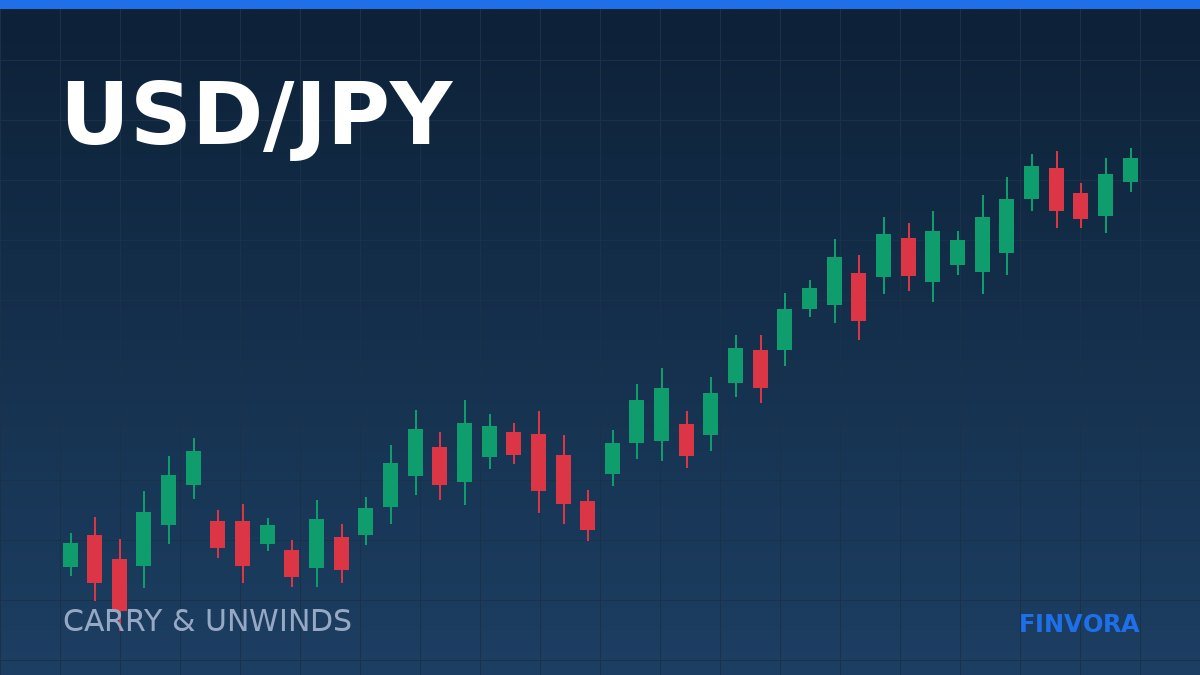
[fv_keypoints]
– Carry returns accrue linearly while unwinds happen in days, producing a deeply asymmetric payoff
– Yen strength during risk-off is a funding effect, not a safe-haven preference
– Intervention risk is a genuine tail in this pair and cannot be managed with a normal stop
[/fv_keypoints]
The mechanics of a carry trade are simple enough to explain in a sentence: borrow in a currency with low interest rates, invest in one with higher rates, and collect the difference. For years the yen has been the world’s default funding currency, which makes USD/JPY less a bet on Japan or the United States than a barometer of global appetite for leverage.
Why the payoff is asymmetric
Carry accrues in small daily increments. It is boring, positive and reliable — right up until it is not. Unwinds are violent because the position is crowded and correlated: the same funding trade sits behind equity longs, emerging-market bonds and commodity positions. When volatility rises, risk models across many institutions demand smaller positions simultaneously, and the exit is through the same door. The result is a payoff profile that looks like collecting coins in front of an occasional bulldozer.
The yen is not a safe haven
The yen tends to strengthen when markets fall, and this is routinely explained as safe-haven demand. The more accurate explanation is mechanical: when leveraged positions are cut, the borrowed yen has to be bought back. That is a funding flow, not a preference. The distinction matters because it tells you when to expect it — during deleveraging, not during bad Japanese news.
Reading the pair
USD/JPY spends long periods trending cleanly, which flatters trend-following and punishes mean reversion. Three features are worth respecting:
- Trends persist longer than they feel like they should, because the carry pays you to stay in and penalises early exits.
- Corrections are sharp but often shallow in trend, and the tell is whether the correction is accompanied by a genuine move in yield spreads or just by an equity wobble.
- Round numbers matter more here than in most pairs, partly because of option barrier structures clustered at them.
Intervention risk
Japanese authorities have a long history of commenting on, and occasionally acting against, disorderly currency moves. The risk is not that intervention is unpredictable in direction — it is always yen-supportive when it comes — but that it arrives in thin liquidity and moves several percent in minutes. A conventional stop does not protect you in that environment because it becomes a market order into a vacuum. The only real defences are smaller size and options structures with defined risk.
A workable discipline
Treat a carry position as a volatility short, because that is what it is. Scale it inversely to implied volatility: when volatility is low and the trade is comfortable, that is when the crowd is largest and the exit narrowest. When volatility has already spiked and the position is painful, the risk has often already been paid.
[fv_chart symbol=”FX:USDJPY” height=”500″]