Index concentration: when a handful of stocks becomes the whole market
A capitalisation-weighted index can rise while most of its members fall. Knowing how much of the move belongs to a few names changes how you read the tape.
Key takeaways
- – Cap-weighted indices give the largest members disproportionate influence over the headline number
- – Breadth measures tell you whether an advance is broad or carried by a few names
- – Concentration raises correlation inside the index and makes drawdowns sharper
A stock index is a weighted average, and the weights matter more than most people trading it realise. In a capitalisation-weighted index, a company worth twenty times another moves the headline number twenty times as much. When a small group of very large companies dominates the total, the index stops describing the market and starts describing them.
Why this changes what the index tells you
The practical consequence is that the index level and the experience of the average constituent can diverge for months. The benchmark makes new highs while the median stock is well below its own. Traders reading the index as a proxy for economic breadth get a signal that is quietly wrong.
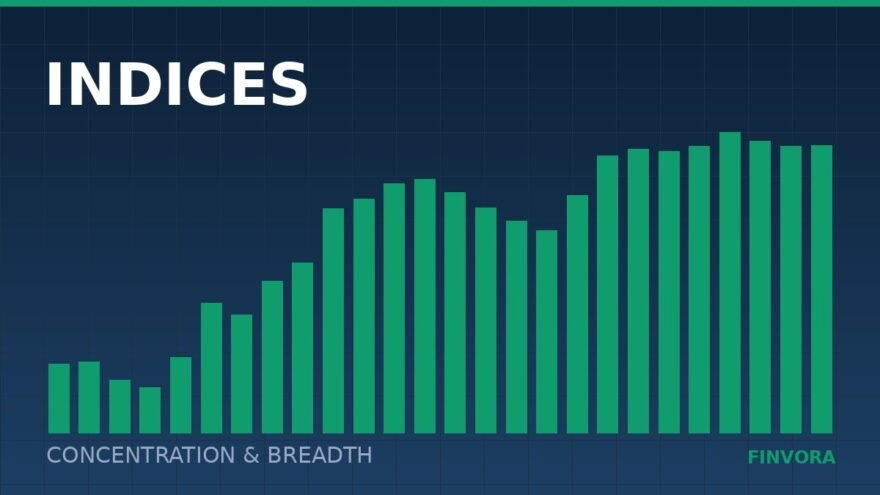
Two measures fix this. The advance-decline line counts how many members rose against how many fell, regardless of size. The equal-weighted version of the same index gives every member the same influence. When the cap-weighted index outperforms the equal-weighted one over a sustained stretch, the advance is narrow.
Concentration and correlation
Concentration also changes the index’s behaviour in a stress event. When a few names carry a large share of the weight, everything that touches those names – a sector rotation, a regulatory headline, a single earnings miss – propagates into the whole index at once. Diversification that exists on paper, across hundreds of members, does not exist in practice.
This is why drawdowns in concentrated markets tend to be faster and deeper than the number of constituents would suggest. The index inherits the volatility of its largest members rather than averaging it away.
What it means for currency traders
Index behaviour is a regime indicator for FX, and a narrow advance is a less reliable one. A benchmark grinding higher on a handful of names does not carry the same message about risk appetite as one rising on broad participation. If you use equity direction to judge whether carry trades are safe, check breadth before trusting the signal.
Practical checks
- Compare the cap-weighted and equal-weighted versions of the same index over three and six months.
- Watch whether new index highs come with expanding or contracting advance-decline readings.
- Treat a rally where breadth is deteriorating as a lower-conviction risk-on signal, not a confirmation.
Related: S&P 500 and the dollar: what the equity tape tells currency traders.