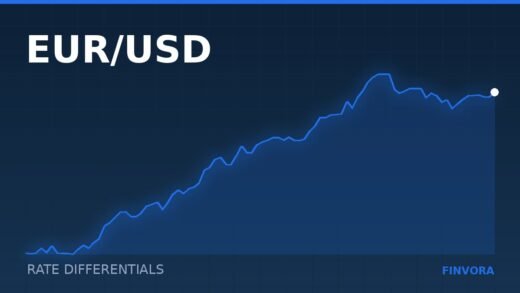
EUR/USD: Why the rate differential still sets the ceiling on any euro rally
Every euro rally of the past two years has run into the same wall: the spread between what the market…
Work out the largest position you can take before a losing trade costs more than you decided to risk.
Position sizing is the part of trading you fully control. You cannot decide whether a trade works; you can decide exactly what it costs when it does not.
Work out how large a position can be before a losing trade costs more than you decided to risk.
For pairs where the US dollar is not the quote currency - USD/JPY, USD/CHF, USD/CAD - and for metals and indices, pip value moves with the market price. Take the figure from your broker's platform and enter it manually rather than assuming ten.
The calculation runs in one direction only. First you fix the amount you are willing to lose – a percentage of account equity, usually somewhere between half a percent and one percent. Then you find the level where the trade idea is objectively wrong, which sets your stop distance. Position size is whatever falls out of dividing the first number by the second.
Doing it the other way round – picking a size first and then placing the stop wherever it happens to fit – is how accounts get into trouble. If the resulting size feels too small to be interesting, the problem is the expectation rather than the arithmetic.
For pairs quoted in US dollars, a standard lot moves roughly ten dollars per pip and the default works. For USD/JPY, USD/CHF, USD/CAD and the crosses, pip value depends on the current exchange rate and shifts as the market moves. Metals, indices and crypto CFDs each use their own contract specification. Read the figure off your platform and enter it rather than assuming.
Further reading: Position sizing: the only part of trading you fully control.
Every euro rally of the past two years has run into the same wall: the spread between what the market…
Real yields, official-sector buying and the dollar do most of the work in gold. Inflation headlines, despite the folklore, do…
The halving cycle shaped every previous Bitcoin bull market. With regulated funds now setting the marginal bid, the framework needs…
The rate decision is rarely the news. The market trades the changed adjectives, the vote split and the projections —…